Tuesday, May 2, 2017

8 signs that your home might be haunted.

Find yourself wondering whether you live in a haunted house? Here are the common signs – and what to do about them…


Not everyone believes in ghosts, spirits and the paranormal. But are there strange goings-on in your home that you sometimes can’t explain? One possible conclusion could be that it’s haunted…
Alison Wynne-Ryder, a psychic medium, believes there’s a few easy ways to tell if your house is home to spirits. And before you think that it’s only old buildings that can be haunted, think again.
With the release of the new Ghostbusters film starring Kristen Wiig and Melissa McCarthy, take a look at how you can tell if your home is haunted...who you gonna call?

What type of buildings can be haunted?

“Although most people you ask would say old properties – or buildings that house many people, such as prisons, hospitals and castles – the reality is that any property can be haunted, even a modern one,” says Alison.
“However, the likelihood is that more old properties tend to have a ‘haunted feeling’ about them, as they have more history and habitation than newer buildings.”

What feelings would I have in a ‘haunted’ property?

• Feelings of being watched or spied on.
• Feelings of someone standing close behind you.
• Feelings of being touched by unseen hands.
• Feelings of the hair on back of your neck standing up.
• Feelings of cobwebs on your face or body.
• Feeling a cold breeze as if someone has walked past you.
• Dark depressing feeling, especially in one particular location.

What are the signs that a building is haunted?

• Lights turning on and off, or up and down, on their own.
• Light bulbs blowing frequently.
• Sounds of items being dropped – but when you go to investigate, there is nothing there.
• Seeing unexplained shadows from the corner of your eye.
• Strange behaviour from pets in the property: e.g. dogs barking or growling at something you cannot see, cats staring in a particular area as if they can see someone.
• Hearing voices of people, whispers, or someone calling your name.
• Seeing twinkling lights, mists or unexplained moving shapes.
• Sudden temperature drops, especially in one area of the property.

·         How do spirits enter a house?
“They can 'reside' anywhere, but there are some traditional beliefs that the spirit enters and leaves through the chimney,” says Alison. “I know through experience that if they want to enter a house, they will enter wherever they wish to – and don't always exit the same way.
“They don't necessarily confine themselves to one area, although if they feel comfortable in a particular area, this will be where most of the activity is felt – such as extremely cold spots, feelings of being touched and so on. 
“For example, there was a spirit boy in my own house a couple of years ago and the sounds he was making seemed to come from within the walls. However, the deep cold I felt was in the spare bedroom, where my grandchildren stayed when they visited. He was drawn to them, making their toys go off on their own, playing with them. During this time, he hid in the wardrobe until I drew him close, communicated with him, and with the help of my medium friend, sent him to the light.”
What should I do if I think my home is haunted?
Alison suggests keeping a diary of events to see if there’s a pattern occurring of unexplained activity.
She also advises to think about when the strange goings-on started, and if something had happened around that time that could be attributed to the activity.
[Read more: Fancy yourself as a ghost buster? Try these 5 free spooky apps on your phone or tablet]
“For example, did someone 'play' with a oujia board, did you stay in a haunted house or castle, or visit an old graveyard?”
“If your home is indeed haunted, this will not go away of its own accord - it will get worse,” says Alison. She advises calling a reputable medium with ‘spirit rescue experience’ to see what they feel or sense, and give you advice.
“If there is a spirit stuck in the home, they will attend with another medium (or two, in case one of them is overshadowed by the spirit) and communicate with the spirit, hopefully sending it to the light.”
Alison Wynne-Ryder is the author of The Quirky Medium.
Is your home haunted? Share your scary tales in the Comments box below.
Ghosts – are they really all that bad?
We asked Alison why spirits are considered evil…
“Ghosts – or spirits as I prefer to call them – often get a bad rap because of the chaos they cause in terms of unexplained activity around people and in the home or place of work.
“When a spirit is stuck between two worlds (they didn't go to the light), they can also affect the personality of someone in the house and even make everyone feel depleted of energy.
“When I was co-host on the TV show Rescue Mediums, one family had to flee their home because their daughter had completely changed in character - the nasty spirit who had attached itself to her was making their life hell.”


Wednesday, April 26, 2017

तुलसी के फायदे

  • तुलसी का पौधा भारत के लगभग हर घर में पाया जाता है. हम इसे पवित्र मानते हैं और इसकी पूजा भी करते हैं.
    यह केवल हमारी आस्था का प्रतीक नहीं है, बल्कि तुलसी के पौधे में कई औषधीय गुण भी मौजूद हैं. आयुर्वेद में
    भी तुलसी के कई उपयोग बताए गए हैं. तुलसी के पौधे के कई उपयोग हैं और इसके फायदे हैं. जिससे हमें कई
    रोगों में लड़ने में सहायता मिलती है. और यह हमें डॉक्टर के पास जाने से बचाता है. सबसे बड़ी बात यह है कि
    तुलसी का कोई साइड इफ़ेक्ट नहीं है और इसका उपयोग किसी भी उम्र का व्यक्ति कर सकता है. तो आइए
    जानते हैं कि तुलसी के क्या-क्या फायदे हैं और इसका उपयोग किस-किस तरह से किया जा सकता है.
  • Toolsi Benefits – तुलसी के फायदे और उपयोग :
  • तुलसी के बीज को चूर्ण बनाकर दही के साथ खाने से खूनी बवासीर खत्म हो जाता है.
  • और तुलसी पत्ता मिला हुआ पानी पीने से कई बीमारियाँ ठीक हो जाती है और कई बीमारियाँ हमसे दूर रहती है.
  • मधु ( शहद ) में तुलसी की पत्तों का रस मिलाकर चाटने से चक्कर आना बंद हो जाता है.
  • तुलसी के कुछ पत्तों को सरसों तेल में भून लीजिए और फिर इसमें लहसुन का रस मिलाकर कान में डाल दीजिए.
    इससे कान के दर्द में आराम मिलेगा.
  • अगर आपको आँखों में जलन की समस्या है, तो आपको हर रात में काली तुलसी का अर्क 2 बूंद आँखों में डालना चाहिए.
  • आपको अक्सर सिर दर्द की समस्या रहती है, तो दवा खाने से बेहतर है कि आप तुलसी का काढ़ा पिएँ.
  • अगर आपके साँसों से दुर्गन्ध आती है, तो तुलसी की कुछ सूखी पत्तियों को सरसों तेल में मिलाकर मुँह
    धोने से आपकी समस्या काफी हद तक कम हो जाएगी. यह उपाय पायरिया में भी उपयोगी है.
  • दाद, खुजली या त्वचा की इन्फेक्शन में तुलसी के अर्क को उस स्थान पर लगाने से फायदा पहुँचता है.
  • अगर आपके मुँह में संक्रमण हो गया हो, तो आपको हर दिन तुलसी के कुछ पत्ते चबाकर खाने चाहिए.
  • दिन में दो बार 10-12 तुलसी के पत्ते खाने से तनाव परेशान नहीं करता है.
  • जिन लोगों को दिल की बीमारी हो, उन्हें भी तुलसी पत्ते का नियमित सेवन करना चाहिए.
  • जिसके गुर्दे में पथरी हो गई हो, उसे शहद में मिलाकर तुलसी के अर्क का लगातार सेवन करना चाहिए.
    छः महीने में असर दिखना शुरू हो जायेगा.
  • शहद, अदरक और तुलसी को मिलाकर बनाया गया काढ़ा ब्रोंकाइटिस, दमा, कफ और सर्दी में लाभदायक है.
  • नमक, लौंग और तुलसी के पत्तों को मिलाकर बनाया गया काढ़ा इंफ्लुएंजा में राहत देता है.
  • तुलसी का अर्क पीने से बुखार कम होता है.

Sunday, April 23, 2017

You Must Do to Grow Your Online Business.

Business forecasts indicate that ecommerce is exploding, which means now is the perfect time for startups to firmly establish their online stores. There are numerous tactics for nurturing a new online business. If you're just getting started, now's the perfect time to make sure all the elements for your online success are in place.
Let’s review 10 crucial steps to capitalizing on this trend:

1. Carefully target the online audience. 

Ecommerce depends largely on a reputable, accessible online presence. To be recognized as such, businesses must make themselves available to those who are most likely to notice. Identify the demographic characteristics of consumers who will benefit from relevant products and services, and base marketing strategies on these details.

2. Create high-quality content and deliver it at high speed.

High-quality content is described as relevant and engaging information that encourages site visitors to return in the future. Content should reflect the given brand in tone and style, and include the company’s mission statement, services and policies. It should also offer industry education and urge interaction with consumers. This may take the form of asking questions, answers to which can be provided in online comment sections. Interaction can also take place via surveys and contest.
For More Help click here - Mct India
But Internet-based businesses live and die by their online visibility and credibility, and they’re judged by more than just consumers. They’re also judged by search engines, which play a major role in bestowing that credibility and visibility. In the wake of recent security vulnerabilities making national headlines such as the Heart Bleed bug, secure web hosting which thwarts vulnerabilities is essential for maintaining credibility, and speedy website load times are essential for delivering a positive user experience, maximizing sales conversions and optimizing from an SEO (search engine optimization) perspective.
Amazon reported a 1 percent revenue increase for every 100 milliseconds improvement in load time. Furthermore, Google has stated that fast load speeds are indeed a factor in the ranking algorithm. In response, VPS hosting is quickly becoming more popular among new businesses looking to maximize site speed, as opposed to traditional, shared hosting services.

3. Personalize content.

Visitors know that unique, individualized web experiences are possible, which is why they expect such features. Take advantage of available technology that can generate shopping selections based on personal preferences. While some of the larger websites (Google, Apple, Facebook, etc.) have apps built into their system that identify users and track their online movements, small businesses might focus on smaller CRM solutions. Batchbook, ContactMe, and Zoho are perfect CRM software solutions for small businesses, each costing less than $20 a month.  

 4. Invest in mobile capabilities. 

Consumer use of mobile devices is greater than ever before, which is why a robust mobile ecommerce platform is crucial. Available solutions include mobile sites, responsive sites, apps, click-to-call tools, maps and real-time notifications.

5. Integrate sales channels.

Enable consumers to experience the brand similarly across all channels of interaction and methods of shopping. Promotions, products, services, company information and policies should be available both on and offline.
For More Help click here - Mct India

6. Consider subscription. 

Subscription commerce occurs in various forms. For instance, the replenishment model allows for a product to be sent to a customer every month or other regular basis. The discovery model provides for new and exciting experiences with each delivery. These may include customized or rare items. It’s up to the company to decide which form of subscription works best for them, and to implement that into their sales and marketing strategies. Most CRM software and programs organize consumer data that can be used to delineate and track which model each customer prefers and whether the customer has subscribed or not.

7. Remember logistics. 

Scalability is integral to growing a business. To accommodate growth, third-parties such as UPS, Nippon Express, or DB Schenker can be depended upon to manage large and complex transactions. Costs will vary based upon the size of the transaction, the size of shipments, the distance that products need to be shipped or the complexity of the transaction. Third-party logistics become more cost effective as a company grows and handles larger transactions. Reverse logistics -- the efficient handling of product exchanges and returns -- is significant as well.
For Internet-based businesses, website speed, security and infrastructure are important foundations of not only logistics, but also SEO. These aspects of online business translate to better search engine visibility, resulting in more traffic, leads, brand credibility and sales. Speeding up your website is crucial for online logistics.

8. Skip the middlemen.

Thanks to the Internet, small businesses can reach consumers quickly and easily. Also, manufacturers are increasingly eager to work directly with small businesses because they realize small brands are likely to bring new and innovative products to the marketplace -- they are less limited by minimal shelf space and complex supply chains.

9. Sell Internet-only merchandise.

Although essential to maintain continuity across multiple sales channels, it is still possible to offer products via the Internet only. Doing so builds an exclusive brand with ecommerce as the core distribution channel. By offering certain products in only one arena, it is possible to maintain greater control over margins.
For More Help click here - Mct India

10. Curate a proprietary selection.

Proprietary selection refers to a strategy dedicated to “curating” a deep but narrow array of exclusive products in a specific segment. These areas give the relevant merchandise the allure of distinction due to original characteristics and the difficulty of locating such a selection elsewhere. 
One of the main goals of any business is consistent growth. Through careful strategic planning, quality marketing campaigns and a healthy combination of the steps outlined above, conversions are likely to increase steadily. 

Tuesday, March 1, 2016

Easy To Create, A 6 Steps Social Media Marketing Plan

Easy To Create, A 6 Steps Social Media Marketing Plan 

Social Media-Marketing-Plan Plan
So now you need to create a social media marketing plan. No easy task, right? Many of us struggle to iron out exactly what that is, let alone how to build one from scratch.
Put simply, every action you take on social networks should be a part of a larger social media marketing strategy. That means every Tweet, reply, like and comment should all be guided by a plan and driving towards pre-determined goals. It might sound complicated, but if you take the time to create a comprehensive social media plan, the rest of your social efforts should follow naturally. Everyone can do this if they approach it correctly.
Learn what a social media marketing plan should include, and follow our 6-step plan for creating your own:

What is a social media marketing plan?

A social media marketing plan is the summary of everything you plan to do and hope to achieve for your business using social networks. This plan should comprise an audit of where your accounts are today, goals for where you want them to be in the near future, and all the tools you want to use to get there.
In general, the more specific you can get with your plan, the more effective you’ll be in its implementation. Try and keep it concise and don’t make your social media marketing strategy so lofty and broad that it’s unattainable. This plan will guide your actions, but it will also be a measure by which you determine whether you’re succeeding or failing at social media. You don’t want to set yourself up for failure from the outset.

Step 1: Create social media objectives and goals

The first step to any social media marketing strategy is to establish objectives and goals that you hope to achieve. Having these objectives also allows you to quickly react when social media campaigns are not meeting your expectations. Without these goals, you have no means of gauging your success and no means of proving your return on investment.
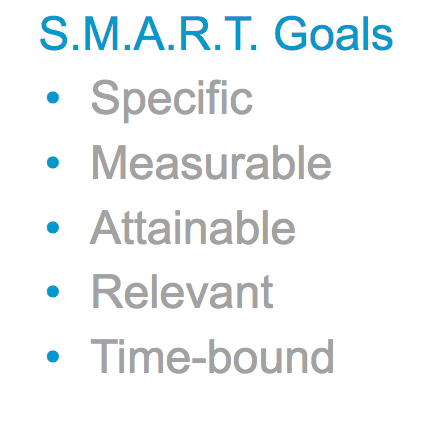
These goals should be aligned with your broader marketing strategy, so that your social media efforts all drive towards business objectives. If your social media marketing strategy is shown to drive business goals forward, you’re more likely to get executive buy-in and investment. They should also go beyond vanity metrics like retweets or Likes, in favour of more advanced metrics like leads generated, sentiment or website traffic referred. Strive to approach these goals using the SMART approach, meaning they should all be specific, measurable, attainable, relevant and time-bound.
A simple way to start your social media marketing plan is by writing down at least threesocial media goals. Make sure to ask yourself what the goal will look like when completed, and use that to determine how you will track it.
A Social media marketing plan should have S.M.A.R.T. goals

For example:
For Instagram we will share photos that communicate our company culture. We will do this by posting 3 photos a week that will achieve 30 likes plus 10 comments each.

Step 2: Conduct a social media audit

Prior to creating your social media marketing plan, you need to assess your current social media use and how it is working for you. This requires figuring out who is currently connecting to you via social media, which social media sites your target market uses and how your social media presence compares to your competitors’.
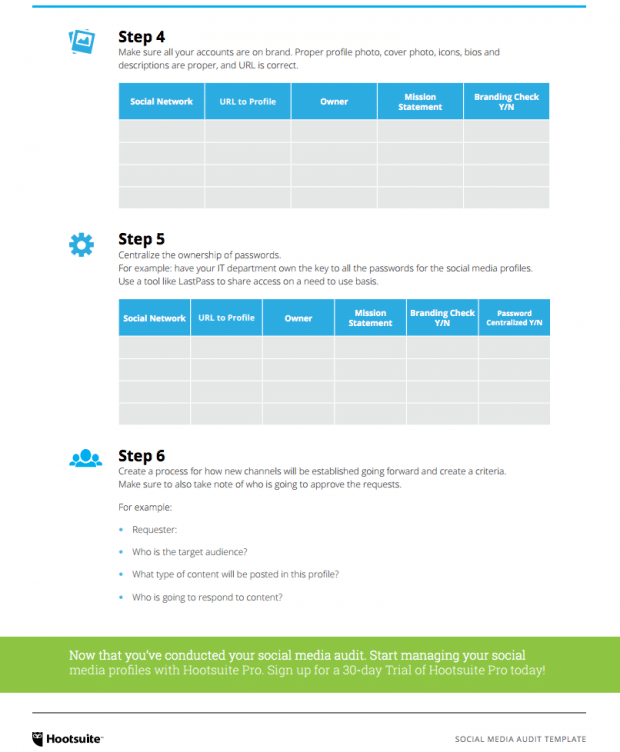
We’ve created a social media audit template that you can follow for each step of the process:
Social Media Audit Template 1
Social Media Audit Template 2
Once you’ve conducted your audit you should have a clear picture of every social account representing your business, who runs or controls them, and what purpose they serve. This ‘living inventory’ should be maintained regularly, especially as you scale your business.
It should also be evident which accounts need to be updated and which need to be deleted altogether. Reporting fraudulent accounts will help ensure that people searching for you online are only connecting with the branded accounts you manage and your approved messaging.
An important part of your social media marketing plan will be to create mission statements for each social network profile. These one-sentence statements will help you focus your attention on a very specific goal you want to accomplish using Facebook, Twitter or any other social network. They will guide your actions and help steer you back on track when these profiles become less effective. They also force you to realize that not every social network is good for the right thing. Instagram might be great for selling a clothing brand, but for construction supplies Facebook might be a better medium. Take the time you need to determine the purpose of every social profile you have. If you can’t figure out its purpose, you should probably delete that profile.
Mission statement example: We will use Instagram to showcase our company culture to recruit new talent.
To help with creating these mission statements, learn about your audience on each profile by using Forrester’s Social Technology Profile Tool. This will provide you with data that classifies consumers into seven levels of how they engage with technology. By profiling your customers’ habits on technology, you’ll be able to gain a clear perspective on where each of your social media profile stands with your customers. 

Step 3: Create or improve your social accounts 

Once you’ve audited your accounts, it’s time to hone your online presence. Choose what networks best meet your social media goals. If you don’t already have social media profiles on each network you focus on, build them from the ground up with your broader goals and audience in mind. If you do have existing accounts, it’s time to refine them and update them for your best possible results.
We’ve created a guide on How to Set-up Facebook, Twitter and Every Other Major Social Network to walk you through that process. Every social network has a different audience and should be treated definitely. See how you can optimize your profiles themselves to meet any of your business goals. Optimizing profiles for SEO can help generate more web traffic to your online properties. Cross-promoting social accountscould help you grow the reach of content. In general, social media profiles should be filled out completely, images and text optimized for the social network in question.
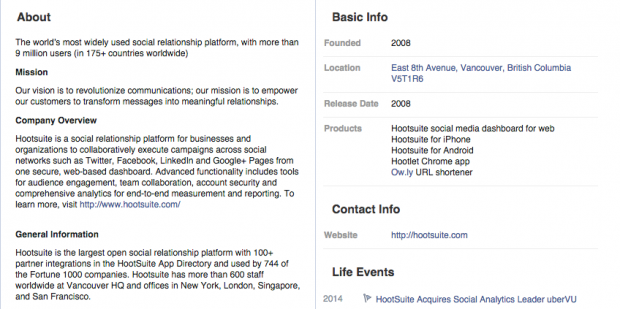
 For your social media marketing plan make sure your social media profiles like your Facebook bio is complete

Step 4: Get social media inspiration from industry leaders, competitors, clients

One of the most important reasons for being active on social media is that your consumers already are. That usually means, so are your competitors. That might not be comforting, but it actually means that there’s a wealth of knowledge already available to you which you can integrate into your social media marketing plan. Turn to your competitors for inspiration when it comes to what content types and information get the most social media engagement. Also, use social media listening to see how you could distinguish yourself from competitors and appeal to consumers they might be missing. 
Consumers can also offer social media inspiration, not only through the content that they share but in the way that they phrase their messages. See how your target audience writes Tweets, and strive to mimic that style. Also learn their habits, when they share and why, and use that as a basis for your social media marketing plan. 
A final source of social media inspiration is industry leaders. There are giants who simply do an incredible job of social media marketing, from Red Bull and Taco Bell to KLM Airlines and Tangerine Bank. Companies in every industry imaginable have managed to distinguish themselves through advanced social media strategies. Follow them and learn everything you can. Don’t be afraid to do research and see if they’ve shared any social media advice or insight elsewhere on the web. 
Here are a few suggested sources of inspiration:
  • Content marketing: Unbounce, Virgin
  • Social media customer service: Tangerine, Warby Parker
  • Social media advertising: AirBnB, the American Red Cross
  • Facebook strategy: Coca-Cola, Walmart
  • Google+ strategy: Cadbury, National Geographic
  • Twitter strategy: Charmin, Oreo
  • Instagram strategy: Herschel Supply Co., General Electric

Step 5: Create a content plan and editorial calendar

Great content will be essential to succeeding at social media. Your social media marketing plan should include a content marketing plan, comprised of strategies for content creation and content curation, as well as an editorial calendar.
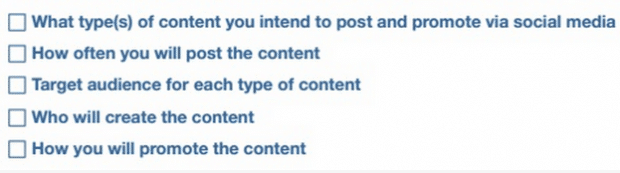
Your content marketing plan should answer the following questions: 
Content Marketing Plan Questions to help your social media marketing plan
Your editorial calendar lists the dates and times you intend to post blogs, Facebook posts, Twitter messages and other content you may plan to use during your social media campaigns. Create the calendar and then schedule your messaging in advance rather than updating constantly throughout the day. You want to work hard on the language and format of these messages anyways. Be spontaneous with your engagement and customer service rather than your content.
 An example an editorial calendar for a social media marketing plan
An example editorial calendar
Make sure your calendar reflects the mission statement you’ve assigned to each social profile. If the purpose of your LinkedIn account is to generate leads, make sure you are sharing enough lead generation content. Hootsuite’s Senior Director of Social Media Jaime Stein recommends establishing a content matrix that defines what share of your profile is allocated to different types of posts. For example: 
  1. 50% of your content will drive back to the blog
  2. 25% of your content will be curated from other source
  3. 20% of your content will drive enterprise content
  4. 5% of your content will be HR and culture
If you’re unsure of how to allocate your resources, a safe bet is to follow the Social Media Rule of Thirds.
  • ⅓ of your social content promotes your business, converts readers, and generates profit.
  • ⅓ of your social content should surface and share ideas and stories from thought leaders in your industry or like-minded businesses.
  • ⅓ of your social content should be based on personal interactions and build your personal brand.

Step 6: Test, evaluate and adjust your social media marketing plan 

To find out what adjustments need to be made to your social media marketing strategy, you should constantly be testing. Build testing capabilities into every action you take on social networks. Track your links using url shorteners and utm codes. Use Hootsuite’s social media analytics to track the success and reach of social campaigns. Track page visits driven by social media with Google analytics. Record and analyze your success and failures, and then adjust your social media marketing plan in response.
Surveys are also a great way you can gauge success. According to Jaime Stein, these work both online and offline. Ask your social media followers, email list and website visitors how you’re doing on social media. This direct approach is often very effective. Then ask your offline customers if social media had a role in their purchasing. This insight might prove invaluable when you look for where to improve. 
The most important thing to understand about your social media plan is that it should be constantly changing. As new networks emerge, you may want to add them to your plan. As you attain goals, you may need to adjust them or find new goals for each network. New challenges might present themselves that you need to address. As you scale your business, you might need to add new roles or grow your social presence for different branches or countries. This is a plan that is meant to change, so be flexible and open to these changes. Rewrite your strategy to reflect your latest insight, and make sure your team is aware of what has been updated. 
This Article Writen By hootsuite.com

Monday, January 5, 2015

Effective Communication

Effective Communication

Improving Communication Skills in Business and Relationships

Effective CommunicationEffective communication helps us better understand a person or situation and enables us to resolve differences, build trust and respect, and create environments where creative ideas, problem solving, affection, and caring can flourish. As simple as communication seems, much of what we try to communicate to others—and what others try to communicate to us—gets misunderstood, which can cause conflict and frustration in personal and professional relationships. By learning these effective communication skills, you can better connect with your spouse, kids, friends, and coworkers.

What is effective communication?

In the information age, we have to send, receive, and process huge numbers of messages every day. But effective communication is about more than just exchanging information; it's also about understanding the emotion behind the information. Effective communication can improve relationships at home, work, and in social situations by deepening your connections to others and improving teamwork, decision-making, and problem solving. It enables you to communicate even negative or difficult messages without creating conflict or destroying trust. Effective communication combines a set of skills including nonverbal communication, attentive listening, the ability to manage stress in the moment, and the capacity to recognize and understand your own emotions and those of the person you’re communicating with.
While effective communication is a learned skill, it is more effective when it’s spontaneous rather than formulaic. A speech that is read, for example, rarely has the same impact as a speech that’s delivered (or appears to be delivered) spontaneously. Of course, it takes time and effort to develop these skills and become an effective communicator. The more effort and practice you put in, the more instinctive and spontaneous your communication skills will become.

Effective communication skills #1: Listening

Listening is one of the most important aspects of effective communication. Successful listening means not just understanding the words or the information being communicated, but also understanding how the speaker feels about what they’re communicating.
Effective listening can:
  • Make the speaker feel heard and understood, which can help build a stronger, deeper connection between you.
  • Create an environment where everyone feels safe to express ideas, opinions, and feelings, or plan and problem solve in creative ways.
  • Save time by helping clarify information, avoid conflicts and misunderstandings.
  • Relieve negative emotions. When emotions are running high, if the speaker feels that he or she has been truly heard, it can help to calm them down, relieve negative feelings, and allow for real understanding or problem solving to begin.

Tips for effective listening

If your goal is to fully understand and connect with the other person, listening effectively will often come naturally. If it doesn’t, you can remember the following tips. The more you practice them, the more satisfying and rewarding your interactions with others will become.
  • Focus fully on the speaker, his or her body language, and other nonverbal cues. If you’re daydreaming, checking text messages, or doodling, you’re almost certain to miss nonverbal cues in the conversation. If you find it hard to concentrate on some speakers, try repeating their words over in your head—it’ll reinforce their message and help you stay focused.
  • Avoid interrupting or trying to redirect the conversation to your concerns, by saying something like, “If you think that’s bad, let me tell you what happened to me.” Listening is not the same as waiting for your turn to talk. You can’t concentrate on what someone’s saying if you’re forming what you’re going to say next. Often, the speaker can read your facial expressions and know that your mind’s elsewhere.
  • Avoid seeming judgmental. In order to communicate effectively with someone, you don’t have to like them or agree with their ideas, values, or opinions. However, you do need to set aside your judgment and withhold blame and criticism in order to fully understand a person. The most difficult communication, when successfully executed, can lead to the most unlikely and profound connection with someone.
  • Show your interest in what’s being said. Nod occasionally, smile at the person, and make sure your posture is open and inviting. Encourage the speaker to continue with small verbal comments like “yes” or “uh huh.”

Effective communication skills #2: Nonverbal communication

When we communicate things that we care about, we do so mainly using nonverbal signals. Wordless communication, or body language, includes facial expressions, body movement and gestures, eye contact, posture, the tone of your voice, and even your muscle tension and breathing. The way you look, listen, move, and react to another person tells them more about how you’re feeling than words alone ever can.
Developing the ability to understand and use nonverbal communication can help you connect with others, express what you really mean, navigate challenging situations, and build better relationships at home and work.
  • You can enhance effective communication by using open body language—arms uncrossed, standing with an open stance or sitting on the edge of your seat, and maintaining eye contact with the person you’re talking to.
  • You can also use body language to emphasize or enhance your verbal message—patting a friend on the back while complimenting him on his success, for example, or pounding your fists to underline your message.

Tips for improving how you read nonverbal communication

  • Practice observing people in public places, such as a shopping mall, bus, train, café, restaurant, or even on a television talk show with the sound muted. Observing how others use body language can teach you how to better receive and use nonverbal signals when conversing with others. Notice how people act and react to each other. Try to guess what their relationship is, what they’re talking about, and how each feels about what is being said.
  • Be aware of individual differences. People from different countries and cultures tend to use different nonverbal communication gestures, so it’s important to take age, culture, religion, gender, and emotional state into account when reading body language signals. An American teen, a grieving widow, and an Asian businessman, for example, are likely to use nonverbal signals differently.
  • Look at nonverbal communication signals as a group. Don’t read too much into a single gesture or nonverbal cue. Consider all of the nonverbal signals you receive, from eye contact to tone of voice to body language. Anyone can slip up occasionally and let eye contact slip, for example, or briefly cross their arms without meaning to. Consider the signals as a whole to get a better “read” on a person.

Tips for improving how to deliver nonverbal communication

  • Use nonverbal signals that match up with your words. Nonverbal communication should reinforce what is being said, not contradict it. If you say one thing, but your body language says something else, your listener will likely feel you’re being dishonest. For example, you can’t say “yes” while shaking your head no.
  • Adjust your nonverbal signals according to the context. The tone of your voice, for example, should be different when you’re addressing a child than when you’re addressing a group of adults. Similarly, take into account the emotional state and cultural background of the person you’re interacting with.
  • Use body language to convey positive feelings even when you're not actually experiencing them. If you’re nervous about a situation—a job interview, important presentation, or first date, for example—you can use positive body language to signal confidence, even though you’re not feeling it. Instead of tentatively entering a room with your head down, eyes averted, and sliding into a chair, try standing tall with your shoulders back, smiling and maintaining eye contact, and delivering a firm handshake. It will make you feel more self-confident and help to put the other person at ease.

Effective communication skills #3: Managing stress

In small doses, stress can help you perform under pressure. However, when stress becomes constant and overwhelming, it can hamper effective communication by disrupting your capacity to think clearly and creatively, and act appropriately. When you’re stressed, you’re more likely to misread other people, send confusing or off-putting nonverbal signals, and lapse into unhealthy knee-jerk patterns of behavior.
How many times have you felt stressed during a disagreement with your spouse, kids, boss, friends, or coworkers and then said or done something you later regretted? If you can quickly relieve stress and return to a calm state, you’ll not only avoid such regrets, but in many cases you’ll also help to calm the other person as well. It’s only when you’re in a calm, relaxed state that you'll be able to know whether the situation requires a response, or whether the other person’s signals indicate it would be better to remain silent.

Quick stress relief for effective communication

When stress strikes, you can’t always temper it by taking time out to meditate or go for a run, especially if you’re in the middle of a meeting with your boss or an argument with your spouse, for example. By learning to quickly reduce stress in the moment, though, you can safely face any strong emotions you’re experiencing, regulate your feelings, and behave appropriately. When you know how to maintain a relaxed, energized state of awareness—even when something upsetting happens—you can remain emotionally available and engaged.
To deal with stress during communication:
  • Recognize when you’re becoming stressed. Your body will let you know if you’re stressed as you communicate. Are your muscles or your stomach tight and/or sore? Are your hands clenched? Is your breath shallow? Are you "forgetting" to breathe?
  • Take a moment to calm down before deciding to continue a conversation or postpone it.
  • Bring your senses to the rescue and quickly manage stress by taking a few deep breaths, clenching and relaxing muscles, or recalling a soothing, sensory-rich image, for example. The best way to rapidly and reliably relieve stress is through the senses: sight, sound, touch, taste, and smell. But each person responds differently to sensory input, so you need to find things that are soothing to you.
  • Look for humor in the situation. When used appropriately, humor is a great way to relieve stress when communicating. When you or those around you start taking things too seriously, find a way to lighten the mood by sharing a joke or amusing story.
  • Be willing to compromise. Sometimes, if you can both bend a little, you’ll be able to find a happy middle ground that reduces the stress levels for everyone concerned. If you realize that the other person cares much more about something than you do, compromise may be easier for you and a good investment in the future of the relationship.
  • Agree to disagree, if necessary, and take time away from the situation so everyone can calm down. Take a quick break and move away from the situation. Go for a stroll outside if possible, or spend a few minutes meditating. Physical movement or finding a quiet place to regain your balance can quickly reduce stress.

Effective communication skills #4: Emotional awareness

Emotions play an important role in the way we communicate at home and work. It’s the way you feel, more than the way you think, that motivates you to communicate or to make decisions. The way you react to emotionally driven, nonverbal cues affects both how you understand other people and how they understand you. If you are out of touch with your feelings, and don’t understand how you feel or why you feel that way, you’ll have a hard time communicating your feelings and needs to others. This can result in frustration, misunderstandings, and conflict. When you don’t address what’s really bothering you, you often become embroiled in petty squabbles instead—arguing with your spouse about how the towels should be hung, for example, or with a coworker about whose turn it is to restock the copier.
Emotional awareness provides you the tools needed for understanding both yourself and other people, and the real messages they are communicating to you. Although knowing your own feelings may seem simple, many people ignore or try to sedate strong emotions like anger, sadness, and fear. But your ability to communicate depends on being connected to these feelings. If you’re afraid of strong emotions or if you insist on communicating only on a rational level, it will impair your ability to fully understand others, creatively problem solve, resolve conflicts, or build an affectionate connection with someone.

How emotional awareness can improve effective communication

Emotional awareness—the consciousness of your moment-to-moment emotional experience—and the ability to manage all of your feelings appropriately is the basis for effective communication.
Emotional awareness helps you:
  • Understand and empathize with what is really troubling other people
  • Understand yourself, including what’s really troubling you and what you really want
  • Stay motivated to understand and empathize with the person you’re interacting with, even if you don’t like them or their message
  • Communicate clearly and effectively, even when delivering negative messages
  • Build strong, trusting, and rewarding relationships, think creatively, solve problems, and resolve conflicts

Effective communication requires both thinking and feeling

When emotional awareness is strongly developed, you’ll know what you’re feeling without having to think about it—and you’ll be able to use these emotional cues to understand what someone is really communicating to you and act accordingly. The goal of effective communication is to find a healthy balance between your intellect and your emotions, between thinking and feeling.

Emotional awareness is a skill you can learn

Emotional awareness is a skill that, with patience and practice, can be learned at any time of life. You can develop emotional awareness by learning how to get in touch with difficult emotions and manage uncomfortable feelings, including anger, sadness, fear, disgust, surprise, and joy. When you know how to do this, you can remain in control of your emotions and behavior, even in very challenging situations, and communicate more clearly and effectively. To learn more, see ourEmotional Intelligence Toolkit.